


Narrow-margin victory bucks rightward shift sweeping across Latin America
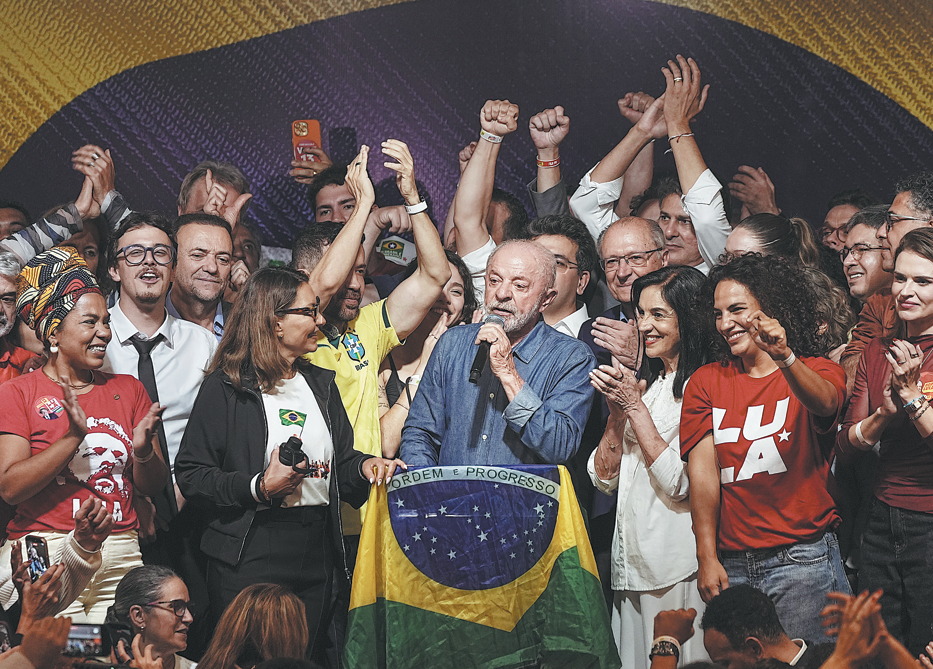
Brazilians re-elected President Luiz Inacio Lula da Silva on Sunday, handing him 51.78 percent of the votes, compared to 48.22 percent for challenger Flavio Bolsonaro.
Lula's victory goes against a shift to the right in recent elections across South America, and will be his fourth term as president.
"I was a presidential candidate nominated by a party, but today my victory belongs to the Brazilian people," Lula said while speaking through a megaphone to cheering supporters gathered outside his home.
Lula was president from 2003 to 2010 and later spent 580 days in prison on corruption convictions, which were annulled by Brazil's Supreme Court in 2021. He went on to defeat then-president Jair Bolsonaro — Flavio Bolsonaro's father — who was convicted and jailed on charges of orchestrating a coup.
Bolsonaro headed into the final ballot as the front-runner, having won 47.03 percent of the vote to 45.16 percent for Lula in the first round of voting on Oct 4. Since neither candidate secured a majority of votes, a runoff was held on Sunday.
It was the first time since 1988 that a candidate has won the runoff after not winning the first round of voting.
Lula will be sworn in on Jan 5,2027, for a four-year term, his fourth as Brazil's president.
Election issues included crime and economic stagnation.
In images similar to President Javier Milei of Argentina, who often posed with a chain saw to symbolize cutting government waste, Bolsonaro wielded a pair of giant scissors as he promised $40 billion in cuts to public spending.
Under Lula, Brazil managed to withstand many of the effects of US President Donald Trump's tariffs, and unemployment remained low.
Commitment to sovereignty
Lula also doubled down on his commitment to Brazil's sovereignty.
"Either the homeland remains free, or we die for Brazil," he said. "This country will not accept being anyone's backyard."
Meanwhile, Bolsonaro, speaking in the Brazilian capital of Brasilia, said it is "impossible" to recognize the results, and called for the annulment of the election.
Countries and groups have congratulated Lula on his victory.
In Latin America, Mexican President Claudia Sheinbaum hailed the result as a victory for the Brazilian people and democracy, while Uruguayan President Yamandu Orsi praised Brazil's electoral process as a celebration of democracy. Cuban President Miguel Diaz-Canel called for stronger regional integration.
EU chief Ursula von der Leyen on Monday hailed Lula's re-election victory as a win for "democracy and multilateralism".
French President Emmanuel Macron on Monday congratulated Lula, calling for efforts to "strengthen our strategic partnership".
China's Foreign Ministry spokesman Guo Jiakun said on Monday that China stands ready to work with Brazil to further advance the building of a China-Brazil community with a shared future.
South American governments have recently been shifting to the right, with Abelardo de la Espriella winning Colombia's presidential election in June, Keiko Fujimori winning Peru's runoff weeks later, and Jose Antonio Kast's victory in Chile in March.
Milei was among the first to start the rightward shift by winning the presidency in Argentina in December 2023.
Many of those governments agree with the US policies on security and drugs, but Lula's victory pushes back against the US influence in the region.
Celso Amorim, a former Lula foreign minister, told Reuters the leftist "would be very important for establishing a point of balance in Latin America. Lula is that balance."
Marcus Vinicius de Freitas, a senior fellow at the Policy Center for the New South, said the region's shift to the right makes coordination harder but does not rule out cooperation.
"Regional integration cannot depend on presidents sharing the same ideology," he said, noting that energy, transportation, trade, border issues and the fight against transnational crime still require joint effort regardless.
Freitas said Lula's experience and broad channels of communication could help Brazil maintain cooperation even with governments that differ politically.
